
Monthly Review – August 2026
OUR PERSPECTIVE – THE PRICE OF SECURITY
“The structural backdrop for U.S. inflation increasingly suggests that the long run equilibrium range is migrating from roughly 1.5–3.5% toward 3.5–4.5%, with a significant risk of episodes of inflation above 5%.” ~ Lacy Hunt, Hoisington Investment Management Company, Quarterly Review and Outlook, Q2 2026
An excellent piece from Lacy Hunt and Van Hoisington this quarter reaches almost exactly the same conclusion as our Fiscal Age thesis: the economic regime changed during the pandemic, and it is unlikely to change back.
The easiest way to understand why is through the production function. Economic output is ultimately determined by labour, capital, natural resources and technology/productivity.
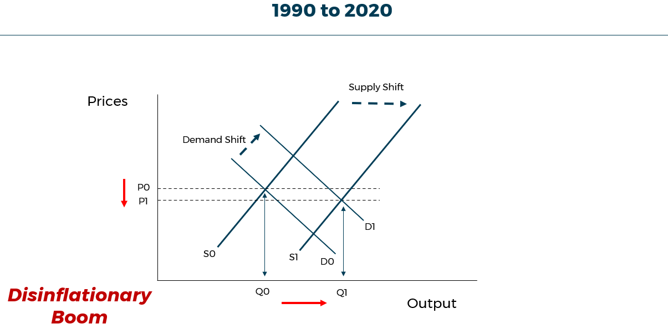
As the charts below show: between 1990 and 2020, almost everything went right.
Globalisation introduced hundreds of millions of workers into the global economy. China became the factory of the world. Supply chains were optimised around just-in-time production. Energy and capital became progressively cheaper, while technology and scale increased efficiency.
In economic terms, aggregate supply shifted to the right.
At the same time, falling interest rates, financialisation and expanding credit supported demand. The result was a 4-decade Disinflationary Boom: output and asset prices increased, while the real cost of producing goods continued to fall.
That world is behind us.
The new objective is no longer efficiency at any cost. It is security at (almost) any cost.
Globalisation is giving way to friend-shoring and localisation. Just-in-time has become just-in-case. Ageing populations and tighter immigration constrain labour supply. Governments want domestic semiconductor production, energy security, larger defence industries, resilient electricity grids and control over critical infrastructure.
All this may be strategically sensible. Almost none are cheap.
Hoisington describes an economy becoming simultaneously more labour-, capital-, energy- and resource-constrained. AI may ultimately deliver enormous productivity gains, but first requires extraordinary quantities of capital, electricity, semiconductors, data centres and infrastructure.
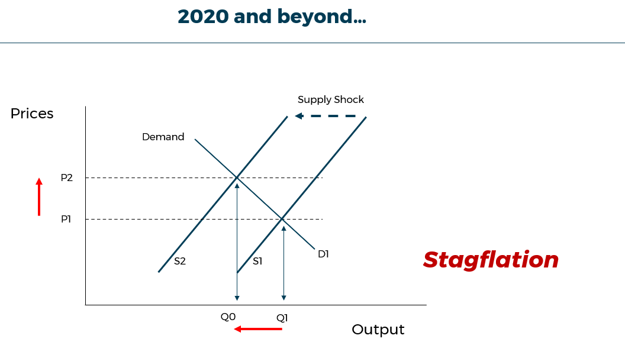
Our second chart therefore captures the essence of the Fiscal Age: the supply curve shifts left. Prices rise and potential output contracts.
That creates an uncomfortable policy dilemma. Higher prices should eventually destroy demand, but short-term, populist governments are unwilling to tolerate the economic pain required for that adjustment. Fiscal stimulus can support growth and employment, but it cannot manufacture skilled workers, electricity, copper or semiconductors overnight.
The consequence is potentially more inflation, higher interest rates, greater interest expense and ultimately the inevitability of financial repression.
The great economic dividend of globalisation was cheaper production.
The price of resilience will be inflation.
Exhibit 1: Globalisation resulted in a meaningful shift in the supply-curve, introducing efficiencies and reducing costs, resulting in increased demand and driving the Deflationary Boom of the last 3 decades.
Source: Shard Capital, 30/08/2026
Exhibit 2: During the Fiscal Age supply costs are likely to increase, and alongside constraints, we are likely to experience a meaningful shift to the left. This will drive an inflationary regime and structurally higher cost of capital.
Source: Shard Capital, 30/08/2026
Financial Repression can be defined as an implicit transfer of wealth from savers to the government, typically achieved by holding interest rates below inflation, destroying the purchasing power of savings while simultaneously reducing the real value and servicing burden of government debt.
Market Review
Deflationary Boom Assets
(Equities, Corporate Bonds, EMD)
Risk assets advanced in August despite a volatile macro backdrop. Global equities rose 2.82% (USD), led by Emerging Markets 3.44% (USD), Japan 3.34% (USD) and the Nasdaq 3.99% (USD). The Magnificent 7 gained 4.44% (USD), supported by another strong Nvidia earnings report and continued confidence in AI-related capital expenditure. U.S. equities gained 2.94% (USD), although valuations remain elevated and increasingly reliant on strong earnings delivery. India remained the laggard at -0.40% (USD), while China gained just 0.67% (USD). Corporate credit produced modest positive returns, while EM hard- and local-currency debt returned 0.74% and 1.02% in USD-terms, respectively.
Deflationary Bust Assets
(Government Bonds)
Government bonds were mixed. U.S. Treasuries returned 0.31% as weak July payrolls initially pushed yields lower, before hotter inflation data and a hawkish Jackson Hole speech from Fed Chair Kevin Warsh reversed the move. The 10-year Treasury yield ended near 4.75%, its highest since January 2025. Gilts gained 0.18% (GBP), while euro-area government bonds fell 0.59% (EUR), reflecting renewed inflation and fiscal concerns.
Inflationary Boom Assets
(Commodities & Managed Futures)
Commodities remained strong. Copper rose 4.41%, industrial metals 2.71% and energy 3.16%, while Brent added 0.41% to $90.49. Copper benefited from tariff uncertainty, AI-related infrastructure demand and constrained non-U.S. supply, while oil remained supported by renewed U.S.-Iran tensions. Managed futures were mixed: the broader CTA index gained 1.75%, but the SG Trend Indicator fell 1.13%, suggesting cross-asset reversals challenged pure trend-following strategies.
Inflationary Bust Assets
(Precious Metals & Inflation-Linked Bonds)
Precious metals were August’s standout performers. Gold surged 9.67% to $4,437/oz and the broader precious-metals index gained 10.32%. Geopolitical uncertainty, fiscal concerns, a softer dollar and renewed “debasement” demand outweighed the headwind from rising real yields. Inflation-linked bonds were mixed: UK linkers gained 0.90%, U.S. TIPS were broadly flat and euro linkers fell 0.24%. Inflation anxiety nevertheless intensified: U.S. PCE inflation reached 3.7%, while UK household inflation expectations rose sharply during August.
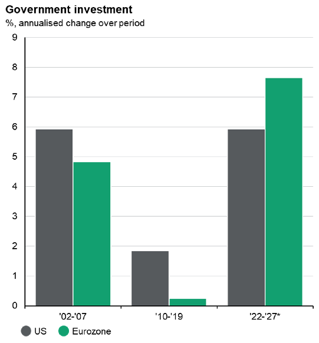
Exhibit 3: We expect a meaningful rise in government investment to be sustained well beyond 2027, which will most likely support higher prices and a higher cost-of-capital. The resulting productivity gains and Return on Investment remains to be the unknown.
Source: OECD, J.P. Morgan Asset Management, Guide to the Markets – UK, 27/08/2026.
CONTACT US
For further information on any of our services, or if you would like to arrange a meeting with an investment manager to see how we can work with you, please get in touch.
Disclaimer:
We try to ensure that the information provided is correct, but we do not give any express or implied warranty as to its accuracy. We do not accept any liability for errors or omissions. The content of this brochure is for guidance purposes only and does not constitute financial or professional advice.
Important information
Shard Capital Partners LLP is a limited liability partnership, registered in England with registration number OC360394. Shard Capital Partners LLP Registered office: Floor 3, 36-38 Cornhill, London, EC3V 3NG. Shard Capital Partners LLP is authorised and regulated by the Financial Conduct Authority in the United Kingdom, reference number 538762.
This document is provided for information purposes only and is intend for confidential and sole use by the recipient. It is not to be reproduced, copied or made available to others. The information set out in this document does not constitute investment advice or a personal recommendation. The views expressed in this document are not intended as an offer or a solicitation, to purchase or sell any security or other financial instrument, credit or lending product or to engage in any investment activity.
Past performance is not a guide to future performance. It is important that you understand that with investments, your capital is at risk. The value of investments, as well as the income derived from them, can go down as well as up and investors may get back less than the original amount invested. It is your responsibility to ensure that you make an informed decision about whether to invest with us, based on your particular objectives. If you are still unsure if investing is right for you, please seek independent advice.
The information and opinions expressed within this document are the views of (the company) and are based on information we believe to be reliable, but we do not represent that they are accurate or complete, and they should not be relied upon as such. Any information provided is given in good faith but is subject to change without notice.
No liability is accepted whatsoever by (the company) or its employees and associated companies for any direct or consequential loss arising from this document.
Disclaimer:
This document is provided for information purposes only and is intend for confidential and sole use by the recipient. It is not to be reproduced, copied or made available to others. The information set out in this document does not constitute investment advice or a personal recommendation. The views expressed in this document are not intended as an offer or a solicitation, to purchase or sell any security or other financial instrument, credit or lending product or to engage in any investment activity.
Past performance is not a guide to future performance. It is important that you understand that with investments, your capital is at risk. The value of investments, as well as the income derived from them, can go down as well as up and investors may get back less than the original amount invested. It is your responsibility to ensure that you make an informed decision about whether to invest with us, based on your particular objectives. If you are still unsure if investing is right for you, please seek independent advice.
The information and opinions expressed within this document are the views of (the company) and are based on information we believe to be reliable, but we do not represent that they are accurate or complete, and they should not be relied upon as such. Any information provided is given in good faith but is subject to change without notice.
No liability is accepted whatsoever by (the company) or its employees and associated companies for any direct or consequential loss arising from this document.