
Time Billionaires: The AI Time Dividend
Quarterly Insights – Q3 2026 | By Ernst Knacke, Head of Investment Research
The Big Picture
“LOST TIME IS NEVER FOUND AGAIN.” ~ Benjamin Franklin
We spend an extraordinary amount of our lives thinking about capital. Mostly money, but financial capital more generally. How much we earn. How much we save. How much our house is worth. How much our investments are worth. Whether we have enough. Whether we will have enough.
On the other hand, we spend very little time thinking about another aspect of capital: human capital. And in particular, one aspect of human capital that is considerably more valuable: time.
One billion seconds is approximately 31 years and eight months. Which means there is a reasonable chance that many people reading this letter are in fact, “Time Billionaires”.
A Time Billionaire has more than one billion seconds left to live. Some may have two billion. A fortunate few could have considerably more.
Suddenly, a billion might not sound quite as unimaginable. Nor does it sound insignificant.
A billion seconds represents almost 280,000 hours. The question is: what are you going to do with it?
That is what this quarterly letter is about. Not interest rates or tariffs. Not government deficits and why we like gold. Not whether the Federal Reserve will again hike rates by 25 basis points at its next meeting despite a weakening labour market.
Instead, I want to think about something bigger: How do we allocate our time? And specifically, whether Artificial Intelligence is about to provide humanity with one of the greatest dividends technological progress has ever delivered: more time.
Life Expectancy
Life expectancy can be a wonderfully misleading statistic. In the UK, period life expectancy at birth is currently around 79 years for men and 83 years for women, according to the United Kingdom’s Office for National Statistics (ONS). (Globally, women live 5 years longer than men, on average. But male readers should not fret, that’s just an average.)
However, if you have already survived childhood, adolescence, your twenties, thirties and beyond, your expected age at death changes.
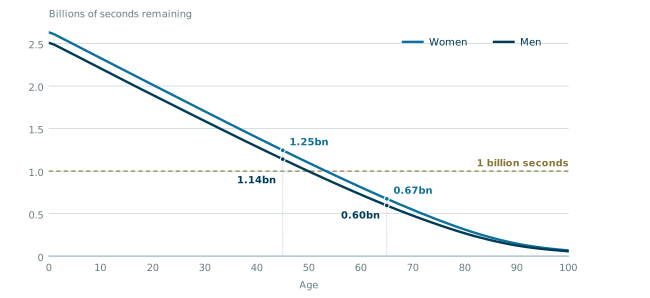
A 45-year-old British man, for example, is statistically expected to live another 36 years, or 1.14 billion seconds. A 45 year of female can expect to live another 39.5 years, or around 1.25 billion seconds. That is, life expectancy is conditional upon having survived everything that came before.
EXHIBIT 1: HOW MANY BILLIONS OF SECONDS DO YOU STATISTICALLY HAVE LEFT?
The chart below shows the expected remaining life for men and women, converted into billions of seconds, at any given age.
Source: ONS, Shard Capital, September 2026
If you are male and have made it to 65, you are expected to live another 600 million seconds, that is almost 19 years!
And this does not incorporate future improvements in healthcare and longevity. Girls born in the UK in 2024 can expect to live to age 90.2 years on average, and boys to age 86.9 years based on projections of cohort life expectancy if we include these expected improvements.
But then, there is another possibility. What if those estimates themselves prove too conservative?
The First AI Dividend: More Time
The popular debate about AI tends to revolve around output. How much more productive will we become? How much faster can an accountant analyse a set of financial statements? How much quicker can a programmer write code? How many customer enquiries can one employee process? How much cheaper will legal, financial, medical or administrative services become?
These are important questions and early evidence is remarkable.
A study involving more than 5,000 customer-support workers found that access to generative AI increased productivity by around 14% on average, with substantially larger improvements amongst less-experienced workers. Another experiment involving Boston Consulting Group consultants found that workers using generative AI completed suitable tasks more than 25% faster while also improving the quality of their work.
We may therefore become considerably more productive. Perhaps significantly more productive.
But the question we are asking is misleading. More productive could mean we produce more. But it could also mean we produce the same with less input. The most tangible dividend from AI will ultimately be something else. Time.
A task that once took four hours might take three. Three hours might become one. Something requiring five people might eventually require two. And an entire category of administrative work may simply disappear. This is not unprecedented.
Indeed, one of the least appreciated achievements of capitalism and technological progress is that we have already been buying ourselves time for generations.
In the mid-19th century, the average worker in many industrialising countries worked somewhere upward of 3,000 hours per year. Today, that number is generally closer to 1,500 hours in wealthy economies. Working hours have roughly halved. We work fewer hours each day, fewer days each week and fewer weeks each year.
Think about what happened to those missing hours. Some became weekends. Some became holidays. Some became retirement. Some became education. Others became football matches, family dinners, Netflix, holidays in Spain, long runs, excessively long lunches and undoubtedly far too much time staring at our phones. But they became ours.
Read the full article by downloading the PDF below:
Before you go: if one billion seconds is roughly 31 years and eight months, where does that leave you? The calculator below uses the same ONS life tables as Exhibit 1 to find out.
Quarterly Insights: Q3 2026
Are you a Time Billionaire?
One billion seconds is roughly 31 years and eight months. Enter your age to see how many seconds UK statistics say you have left to spend.
seconds remaining, on average, and counting
Source: ONS national life tables; Shard Capital. Figures show average expected remaining life for the UK population at each age, converted into seconds. They are statistical averages for illustration only, not a personal prediction, and do not account for individual health or circumstances. The AI time dividend is a scenario described in Shard Capital’s Quarterly Insights Q3 2026, not a forecast. This tool does not store or transmit any information you enter.
CONTACT US
For further information on any of our services, or if you would like to arrange a meeting with an investment manager to see how we can work with you, please get in touch.
Disclaimer:
We try to ensure that the information provided is correct, but we do not give any express or implied warranty as to its accuracy. We do not accept any liability for errors or omissions. The content of this brochure is for guidance purposes only and does not constitute financial or professional advice.
Important information
Shard Capital Partners LLP is a limited liability partnership, registered in England with registration number OC360394. Shard Capital Partners LLP Registered office: Floor 3, 36-38 Cornhill, London, EC3V 3NG. Shard Capital Partners LLP is authorised and regulated by the Financial Conduct Authority in the United Kingdom, reference number 538762.
This document is provided for information purposes only and is intend for confidential and sole use by the recipient. It is not to be reproduced, copied or made available to others. The information set out in this document does not constitute investment advice or a personal recommendation. The views expressed in this document are not intended as an offer or a solicitation, to purchase or sell any security or other financial instrument, credit or lending product or to engage in any investment activity.
Past performance is not a guide to future performance. It is important that you understand that with investments, your capital is at risk. The value of investments, as well as the income derived from them, can go down as well as up and investors may get back less than the original amount invested. It is your responsibility to ensure that you make an informed decision about whether to invest with us, based on your particular objectives. If you are still unsure if investing is right for you, please seek independent advice.
The information and opinions expressed within this document are the views of (the company) and are based on information we believe to be reliable, but we do not represent that they are accurate or complete, and they should not be relied upon as such. Any information provided is given in good faith but is subject to change without notice.
No liability is accepted whatsoever by (the company) or its employees and associated companies for any direct or consequential loss arising from this document.
Disclaimer:
This document is provided for information purposes only and is intend for confidential and sole use by the recipient. It is not to be reproduced, copied or made available to others. The information set out in this document does not constitute investment advice or a personal recommendation. The views expressed in this document are not intended as an offer or a solicitation, to purchase or sell any security or other financial instrument, credit or lending product or to engage in any investment activity.
Past performance is not a guide to future performance. It is important that you understand that with investments, your capital is at risk. The value of investments, as well as the income derived from them, can go down as well as up and investors may get back less than the original amount invested. It is your responsibility to ensure that you make an informed decision about whether to invest with us, based on your particular objectives. If you are still unsure if investing is right for you, please seek independent advice.
The information and opinions expressed within this document are the views of (the company) and are based on information we believe to be reliable, but we do not represent that they are accurate or complete, and they should not be relied upon as such. Any information provided is given in good faith but is subject to change without notice.
No liability is accepted whatsoever by (the company) or its employees and associated companies for any direct or consequential loss arising from this document.