
You Don’t Need a Long Memory.
Written by Julian Wheeler – Partner and US Equity Specialist
Correctly predicting the top price “at the top” of any asset, after it has had a spectacular and well above average gain, is one of the hardest things to do in investing; so, the usual advice is to not even try to do it. But whenever the price breaks (as it always does) and moves meaningfully lower, it means that you have finally reached the point where more owners wish to sell than there are new entrants who wish to get involved. At that point you should now sell rallies rather than buy dips.
While this sounds like I am just stating the bleeding obvious, it is amazing how few people follow that path. It reminds me of people who say, they must ‘get around to stopping smoking’ – they think about it, but don’t do it. Psychology comes into play, a certain remorse at not getting out at that higher price and the hope that it will recover once again.
A quick blast on my own trumpet; I said exactly this about Silver back in February on here and explained in more detail why I thought it would fall in my February OTP piece “a silver bullet for investors”. The initial collapse in January was indeed followed by a sharp rally giving you selling opportunity before the long and substantial decline that is still in progress.
I now believe that the same euphoric top that accompanied the final rise in Gold and Silver at the start of this year, occurred with Semiconductor stocks in mid-June. ETFs related to that sector took in more new investor money in that one week than during any other single one on record, which is as good a sign of a top as capitulation selling is in marking a bottom. As a sentiment indicator of extreme greed, it also neatly coincided with the other predictable top in the level of investor froth: the launch (if that is the appropriate word) of Space X.
Since then, the purest means of exposure to Memory Chips – the South Korea KOSPI Index – has now fallen 40% from its peak. Therefore, I believe we have seen a similar break in the hottest part of the market this year: the Memory stocks and the Semiconductors. They represent the pinnacle of the AI capital spending trade; they are the ‘picks and shovels’ of this goldrush and it is time you put them back in the shed.
What else do I have apart from the decline in stock prices?
Let us remember that all these companies and their products are cyclical – yes, they jolly well are and it is NEVER different. Run very quickly from anyone telling you it is! It doesn’t matter why or what causes an increase in demand, but if it is sudden and sufficiently large it will lead to shortages, which in turn leads to price increases and at this point the suppliers make huge amounts of profits and up go the shares as everyone falls over themselves in their eagerness to forecast ever higher prices. But then, at some point, several things can happen to break the cycle. Any or all of these predict that things are likely to be less good than they were just a short time ago.
Ignore chatter of this being a different, superior product: this stuff is a commodity first and foremost. And thus, as always., the availability of supply will start to turn up – witness most, if not all, of the component makers recent announcements of capacity increases. Customers will start to look elsewhere – alternative types of storage are considered; you will hear the word ‘optimisation’. It all means do more with less. Apple has even petitioned the US Administration to be allowed to buy DRAM from China. Most telling of all, Micron announced that it was looking to move customers on to long term contracts. Well, they would hardly want to do that if they thought prices were still likely to rise!
There are a few golden rules with cyclical companies: one is to ignore the growth rate of earnings but instead focus on the rate of change of that growth. Once that slows down, you want to get out, long before profits themselves start to decline. It is why Nvidia has been dead money for the last year: the market expectations caught up with reality. As a result, to do well, you need to buy all cyclical stocks when they appear ‘expensive’, even loss making and you should sell them when they are making bumper profits and look ‘cheap’. The second rule is that the turning points are hairpin sharp and you will only pick them with luck, because the shares, driven by sentiment, always go both higher and lower than you expect.
You should not value these companies on multiples of earnings: because those earnings are so inconsistent over a cycle that not even the management can estimate them accurately. I think Price / Book Value is a much better assessment of a company’s worth and better indicates where you are in the cycle. How much of a boom have we seen then and how much of a bust is coming?
This is Micron over its history as a public company:
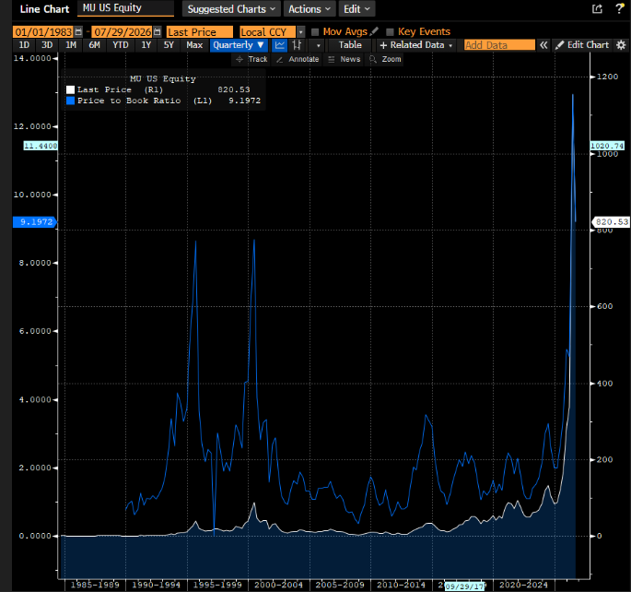
Source: Bloomberg, 30th July 2026
WHITE line is the share price: note all previous history is now dwarfed by the current move.
BLUE line is Price / Book value: concentrate on the Blue line.
The two previous greatest cycles in DRAM prices came in the Wintel PC upgrade of 1995 and the Dotcom boom of 2000 and on both occasions MU shares peaked at about 8.5x P/BV with gross margins topping out close to 50%. But this time the stock has risen much higher, all the way up to 13x Book. This can be justified by the fact that Micron’s gross margins last quarter hit a new record and were even higher than Nvidia’s at an almost extortionate 84%. So, like the much higher valuation, it was more than 50% better than previous peaks.
The reason they can make this level of profit on each widget nowadays is because there are only three players left in the DRAM industry, who are operating a much more effective cartel than OPEC and so they can set prices where they choose. The problem is that they have some very large customers who are not particularly happy with this situation. Judging by the reception given to the new Chinese entrant, who have come from nowhere to take 8% global share so far, it is not going to get any better than this. And every time in history when that happens – we go down.
How far down? As the chart shows, since the bust in 2000 and before last year’s boom, the highest rating that Micron has ever been awarded is 3x and as recently as 2022 it was trading at exactly ONE multiple its book value of $48. The current book value is $89. One of the most bullish analysts estimates that it will have rocketed to $280 by the end of 2027, such is their current level of cash generation. But even if that rosiest scenario comes to pass, to hold the stock from here, you need to believe that the cycle of valuation that has held for over 30 years is now broken.
But if I am right then the bottom is anywhere between $280 and $470: is there a word for half a micron?
For more background on our U.S. market views, visit the Over the Pond archive.
Contact Us
For further information on any of our services, or if you would like to arrange a meeting with an investment manager to see how we can work with you, please get in touch.
Important information
Shard Capital Partners LLP is a limited liability partnership, registered in England with registration number OC360394. Shard Capital Partners LLP Registered office: Floor 3, 36-38 Cornhill, London, EC3V 3NG. Shard Capital Partners LLP is authorised and regulated by the Financial Conduct Authority in the United Kingdom, reference number 538762.
Disclaimer:
We try to ensure that the information provided is correct, but we do not give any express or implied warranty as to its accuracy. We do not accept any liability for errors or omissions. The content of this brochure is for guidance purposes only and does not constitute financial or professional advice.
This document is provided for information purposes only and is intend for confidential and sole use by the recipient. It is not to be reproduced, copied or made available to others. The information set out in this document does not constitute investment advice or a personal recommendation. The views expressed in this document are not intended as an offer or a solicitation, to purchase or sell any security or other financial instrument, credit or lending product or to engage in any investment activity.
Past performance is not a guide to future performance. It is important that you understand that with investments, your capital is at risk. The value of investments, as well as the income derived from them, can go down as well as up and investors may get back less than the original amount invested. It is your responsibility to ensure that you make an informed decision about whether to invest with us, based on your particular objectives. If you are still unsure if investing is right for you, please seek independent advice.
The information and opinions expressed within this document are the views of (the company) and are based on information we believe to be reliable, but we do not represent that they are accurate or complete, and they should not be relied upon as such. Any information provided is given in good faith but is subject to change without notice.
No liability is accepted whatsoever by (the company) or its employees and associated companies for any direct or consequential loss arising from this document.